The Bells of Saint Mary's
St Mary's Ecclesfield has a ring of 10 bells. The heaviest (the Tenor) weighs 14cwt 1qr 22lb or 734kg.
The bells are in the top part of the tower (the belfry), the room behind the wooden louvre windows. The louvres allow the sound out but keep the weather and birds from getting in. The bell frame is just below the level of the louvre windows so that the sound has to rise and mix before it escapes to the wider world. This improves the sound quality and stops a bell near a particular window from sounding louder than the others.
Before they can be rung in changes, the bells must be rung up to their raised position (upside down). Once there, they rotate full circle and strike once, then rotate back full circle and strike once more. The motion is controlled by the ringer through the rope. It is this control that allows a ringer to place a bell in the right place in the changes. The photo below shows the bells in the raised (up) position.

The bells viewed from above, they are in the 'up' position.
The bells are arranged in the bell frame so that they turn at 90 degrees to each and in opposite directions, this evens out the dynamic loads on the tower. Each bell swings on double row self-aligning ball bearings.
The bells were cast at different times over 5 centuries by 4 bell founders. The oldest bell in the ring of 10 is the 9th, it is dated c1590. In the 1600's Ecclesfield had 4 bells, then 2 were added in 1745 to make 6, and in 1845 two more were added and 2 recast to create an octave in the key of F. It remained like this for 166 years until 2011 when 2 more were added, 2 recast and all but the 9th tuned to form the ring of 10 in the key of E we ring today.
Through the centuries the bells were hung in wooden frames but the last wooden frame was replaced with the present metal one in 1952 by Gillett and Johnston of Croydon. They overhauled the fixtures and fittings and had the bells at their foundry while the frame was constructed.
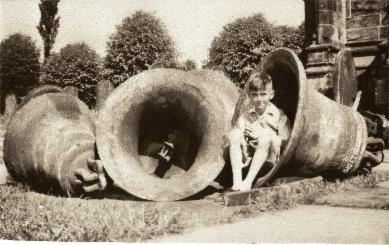
The photo below is taken in the Churchyard on the day the bells were lowered from the tower by Gillett and Johnston. Sitting inside the 7th is Alan Smith, son of Les Smith who was Tower Captain at Ecclesfield for many years and a ringer at Sheffield Cathedral. The photo and permission to use it was kindly given by Les's family.
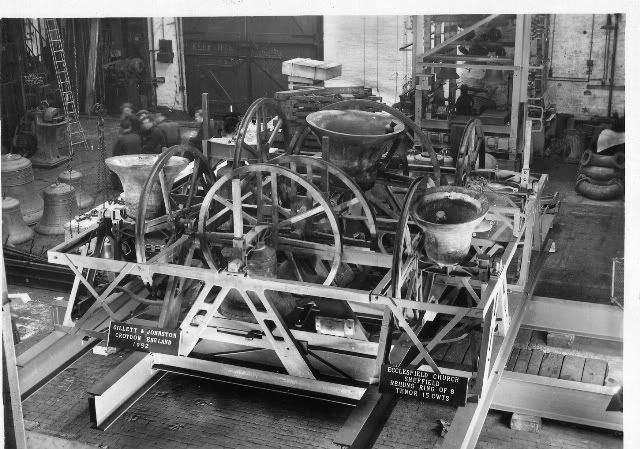
As a result of the work in 1952 the bell ropes were hung so that the rope circle was clockwise from 1 to 8, previously it had been anti-clockwise which was unusual. The bell strike notes were also re tuned at this time. The total cost of all the work was £1500. The bells were rededicated on 22nd May 1952. The photograph below is of the bells in their new frame while still at the works of Gillett and Johnston's of Croydon in 1952.
In 2011 the bells were again removed from the tower this time by the Whitechapel Bell Foundry in preparation for adding 2 more bells. They were taken to the foundry in London where retuning was carried out to 5 of the original 8 bells. 2 were recast and 2 brand new bells were cast. No tuning work was carried out to the original 7th (now the 9th). All the bearings were replaced and the wrought iron clappers refurbished with new crown staples and stainless steel pivot pins. The sides of the treble and 4th pits were removed. New framework was added to the existing frame to take the extra 2 bells and to reorder the others.
The photo below is the bells when they were delivered back from Whitechapel Bell Foundry.

The Sanctus Bell
We have one other bell in the belfry called a Sanctus bell. It's only small and not hung for change ringing, it can only be chimed and serves no purpose now. It has always been known to the ringers as Tom Tinkler. It is mentioned in the churchwardens' accounts for 1587 as "the lyttle Santys bell. The purpose of a Sanctus bell was to signal to the village and those not able to attend the service that Mass was being celebrated.
The Sanctus bell is dated c1580 making it the oldest bell in the tower. It is 15" diameter mounted on a timber headstock and weighs approximately 3/4 cwt. There is no inscription on the bell but it does bear the arms of Wombwell of Thundercliffe Grange. The wrought iron clapper is held by a cast-in crown staple. It is mounted on steel gudgeons running in plain gunmetal bearings on a small sub frame on top of the main bell frame. It can be chimed from the ringing chamber by pulling the rope attached to the lever that projects from the headstock. We do occasionally give the rope a pull, so listen out for it.
We have not managed to find any information about who cast the Sanctus bell.
 The Sanctus Bell (TomTinker)
The Bells
| Number | Note | Inscription | Cwts | Qrs | Lbs | Diameter |
1 | G# | TO THE MEMORY OF THE GLEDHILL FAMILY OF ECCLESFIELD. VICAR REV'D. D.G. HARTLEY | 4 | 1 | 1 | 25¼" |
2 | F# | PEOPLE WILL NOT LOOK FORWARD TO POSTERITY WHO NEVER LOOKED BACKWARD TO THEIR ANCESTORS. VICAR REV'D. D.G. HARTLEY | 4 | 2 | 24 | 26½" |
3 | E | C & G Mears, Founders London Reve Alfred Gatty M.A. Vicar J.B. Greaves, H. Moorwood, J. Machen, J. Ashforth Churchwardens 1845 A GIFT FROM THE SHEFFIELD BRANCH 100 CLUB RECAST WHITECHAPEL 2011 | 5 | 0 | 2 | 28" |
4 | D# | C & G Mears, Founders London Reve Alfred Gatty M.A. Vicar J.B. Greaves, H. Moorwood, J. Machen, J. Ashforth Churchwardens 1845 RECAST WHITECHAPEL 2011 | 5 | 0 | 18 | 28¾" |
5 | C# | The gift of John Watts, Esquire A. Walker, I. Ludlam Founders, 1750 | 5 | 0 | 25 | 30" |
6 | B | The gift of John Watts, Esquire A. Walker, I. Ludlam Founders, 1750 | 5 | 3 | 0 | 31¼" |
7 | A | C. & G. Mears founders London 1844 | 6 | 0 | 24 | 34⅝" |
8 | G# | C. & G. Mears founders London 1844 The 3rd and fourth bells in the original peal of six were recast and the trebles added in 1845 J.B. Greaves, J. Machen, J. Ashforth, Churchwardens 1845 | 6 | 2 | 9 | 35¾" |
| 9 | F# | Hec campana sacra fiat trinitate beata H.O. | 9 | 0 | 20 | 38¼" |
| 10 | E | Jesus Be Our Speed 1617 OD RS IS FB TH | 14 | 1 | 22 | 44½" |
Tenor Nominal = 671.5 cycles per second or 671.5Hz.
The 9th bell was cast by Henry Dand c1590. The translation of the Latin inscription is: Let this bell be made holy by the blessed trinity

On the bell are the initials HD. In the letter h is a small face.
The 10th (Tenor) bell was cast by William Oldfield (of York) in 1617.
The 9th, 10th and Sanctus bells are included in the Church of England, Database of Historically Significant Bells
See Dove's Guide For Church Bell Ringers entry for Ecclesfield
Canons
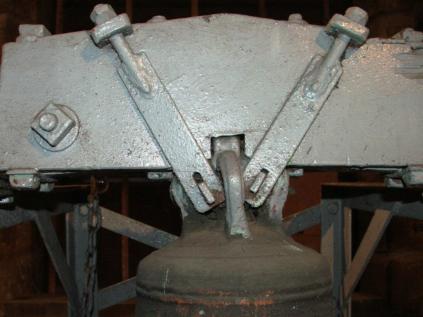
Canons are the metal loops cast at the top of the bell. They are the means of attaching it to a wooden headstock. The Treble, 2nd, 3rd and 4th were new in 2011 and don't have canons. 5,6,7,8 have had their canons removed at some time in the past.
The 9th and 10th bells still have their canons, 6 on each bell, this is an interesting historical feature. To preserve the bells in their original state they are mounted in special canon retaining metal headstocks. Now bolts go through the headstock and the crown of the bell to secure it to the headstock. The canons are not under any stress.
The Sanctus bell also has 6 canons and is the only one mounted in the traditional way on a wooden headstock with straps to the canons.
The top of the Sanctus bell showing the canons and the timber headstock.
Muffled and Half Muffled Ringing

Commemorative ringing is undertaken with the bells half-muffled. Leather pads are tied to each clapper but only on one side. As the bells swing in one direction, the side of the clapper without the pad will strike the bell normally, as the bells swing back, the side of the clapper with the pad will strike producing a quieter muffled sound. It produces a lovely quiet echo reserved for sad or solemn occasions.
Fully muffled ringing is not usually carried out. It might be if the death of a sovereign was announced.
To contact us about anything on this web site or ringing at Ecclesfield, please email: ecclesfieldtower@hotmail.co.uk